From the Paria River
through Grand Canyon
by John Wesley Powell
From “The Exploration of the Colorado River of the West and Its Tributaries”
published in 1875.
To–day the walls grow higher and the cañon much narrower. Monuments are still seen on either side; beautiful glens and
alcoves and gorges and side cañons are yet found. After dinner we
find the river making a sudden turn to the northwest and the whole
character of the cañon changed. The walls are many hundreds of feet
higher, and the rocks are chiefly variegated shales of beautiful colors—creamy orange above, then bright vermilion, and below, purple and
chocolate beds, with green and yellow sands. We run four miles
through this, in a direction a little to the west of north, wheel again to
the west, and pass into a portion of the cañon where the characteristics
are more like those above the bend.
At night we stop at the mouth of
a creek coming in from the right, and suppose it to be the Paria; which
was described to me last year by a Mormon missionary.
Here the cañon terminates abruptly in a line of cliffs, which stretches from
either side across the river.
With some feeling of anxiety we enter a new cañon this
morning. We have learned to observe closely the texture of the rock.
In softer strata we have a quiet river, in harder we find rapids and falls.
Below us are the limestones and hard sandstones which we found in
Cataract Cañon. This bodes toil and danger. Besides the texture
of the rocks, there is another condition which affects the character
of the channel, as we have found by experience. Where the strata are
horizontal the river is often quiet, and, even though it may be very
swift in places, no great obstacles are found. Where the rocks incline
in the direction traveled, the river usually sweeps with great velocity,
but still has few rapids and falls. But where the rocks dip up stream
and the river cuts obliquely across the upturned formations, harder
strata above and softer below, we have rapids and falls. Into hard rocks
and into rocks dipping up stream we pass this morning and start on
a long, rocky, mad rapid. On the left there is a vertical rock, and
down by this cliff and around to the left we glide, tossed just enough by
the waves to appreciate the rate at which we are traveling.
The cañon is narrow, with vertical walls, which gradually grow
higher. More rapids and falls are found. We come to one with a drop
of sixteen feet, around which we make a portage, and then stop for
dinner. Then a run of two miles, and another portage, long and difficult; then we camp for the night on a bank of sand.
Cañon walls, still higher and higher, as we go down
through strata. There is a steep talus at the foot of the cliff, and in
some places the upper parts of the walls are terraced.
About ten o’clock we come to a place where the river occupies the entire
channel and the walls are vertical from the water’s edge. We see a
fall below and row up against the cliff. There is a little shelf, or rather
a horizontal crevice, a few feet over our heads. One man stands on the
deck of the boat, another climbs on his shoulders, and then into the
crevice. Then we pass him a line, and two or three others, with myself,
follow; then we pass along the crevice until it becomes a shelf, as
the upper part, or roof, is broken off. On this we walk for a short
distance, slowly climbing all the way, until we reach a point where
the shelf is broken off, and we can pass no farther.
So we go back
to the boat, cross the stream, and get some logs that have lodged in
the rocks, bring them to our side, pass them along the
crevice and shelf, and bridge over the broken place. Then
we go on to a point over the falls, but do not obtain a satisfactory
view. So we climb out to the top of the wall and walk
along to find a point below the fall from which it can be seen.
From this point it seems possible to let down our boats with
lines to the head of the rapids, and then make a portage; so
we return, row down by the side of the cliff as far as we
dare, and fasten one of the boats to a rock. Then we let
down another boat to the end of its line beyond the first, and
the third boat to the end of its line below the second, which
brings it to the head of the fall and under an overhanging rock.
Then the upper boat, in obedience to a signal, lets go; we
pull in the line and catch the nearest boat as it comes, and then the last.
Then we make a portage, and go on.
We go into camp early this afternoon at a place where it seems
possible to climb out, and the evening is spent in ‘making observations
for time.’
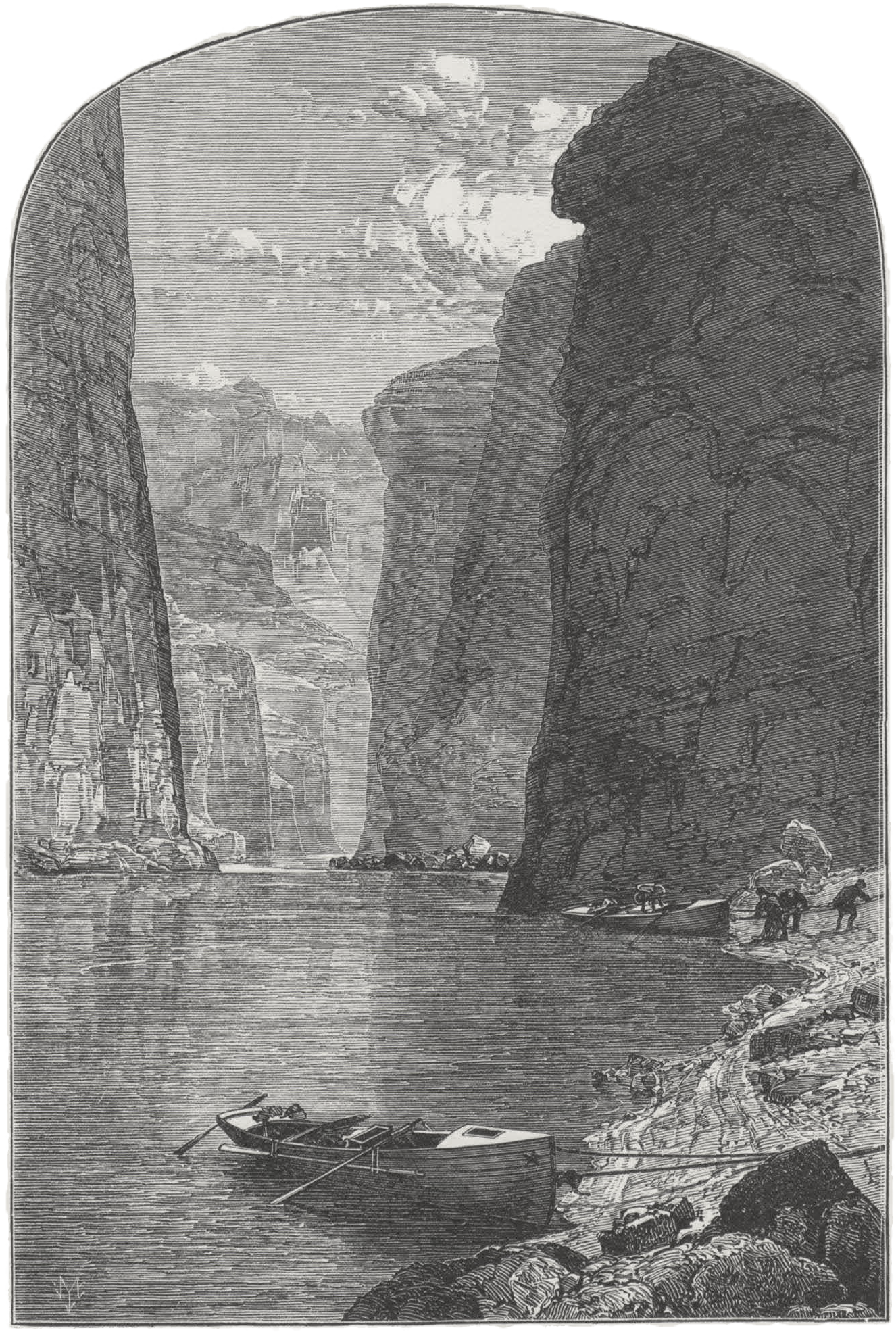
Figure 25—Noon–day rest in Marble Cañon.
— August 7 —
The almanac tells us that we are to have an eclipse of the
sun to–day; so Captain W.H. Powell and myself start early, taking our instruments
with us for the purpose of making observations on the eclipse
to determine our longitude. Arriving at the summit, after four
hours’ hard climbing to attain 2,300 feet in height, we hurriedly build a
platform of rocks on which to place our instruments, and quietly
wait for the eclipse; but clouds come on and rain falls, and sun and
moon are obscured.
Much disappointed, we start on our return to camp, but it is late
and the clouds make the night very dark. We feel our way down
among the rocks with great care for two or three hours, making slow
progress indeed. At last we lose our way and dare proceed no farther.
The rain comes down in torrents and we can find no shelter. We can
neither climb up nor go down, and in the darkness dare not move
about; so we sit and ‘weather out’ the night.
Daylight comes after a long, oh! how long, a night, and
we soon reach camp. After breakfast we start again, and make two
portages during the forenoon.
The limestone of this cañon is often polished, and makes a beautiful
marble. Sometimes the rocks are of many colors—white, gray, pink,
and purple, with saffron tints. It is with very great labor that we make
progress, meeting with many obstructions, running rapids, letting down
our boats with lines from rock to rock, and sometimes carrying boats
and cargoes around bad places. We camp at night, just after a hard
portage, under an overhanging wall, glad to find shelter from the
rain. We have to search for some time to find a few sticks of driftwood,
just sufficient to boil a cup of coffee.
The water sweeps rapidly in this elbow of river, and has cut its
way under the rock, excavating a vast half–circular chamber, which,
if utilized for a theater, would give sitting to 50,000 people. Objection
might be raised against it, however, for at high water the floor is
covered with a raging flood.
And now the scenery is on a grand scale. The walls of
the cañon, 2,500 feet high, are of marble, of many beautiful colors,
often polished below by the waves, and sometimes far up the sides,
where showers have washed the sands over the cliffs.
At one place I
have a walk for more than a mile on a marble pavement, all polished
and fretted with strange devices and embossed in a thousand fantastic
patterns. Through a cleft in the wall the sun shines on this pavement
and it gleams in iridescent beauty.
I pass up into the cleft. It is very narrow, with a succession of pools
standing at higher levels as I go back. The water in these pools is clear
and cool, coming down from springs. Then I return to the pavement,
which is but a terrace or bench, over which the river runs at its flood,
but left bare at present. Along the pavement in many places are basins
of clear water, in strange contrast to the red mud of the river. At
length I come to the end of this marble terrace and take again to
the boat.
Riding down a short distance, a beautiful view is presented. The
river turns sharply to the east and seems inclosed by a wall set with
a million brilliant gems. What can it mean? Every eye is engaged,
every one wonders. On coming nearer we find fountains bursting from
the rock high overhead, and the spray in the sunshine forms the gems
which bedeck the wall. The rocks below the fountain are covered with
mosses and ferns and many beautiful flowering plants. We name it
Vasey’s Paradise, in honor of the botanist who traveled with us last
year.
We pass many side cañons to–day that are dark, gloomy passages
back into the heart of the rocks that form the plateau through which
this cañon is cut.
It rains again this afternoon. Scarcely do the first
drops fall when little rills run down the walls. As the storm comes
on, the little rills increase in size, until great streams are formed.
Although the walls of the cañon are chiefly limestone, the adjacent
country is of red sandstone; and now the waters, loaded with these
sands, come down in rivers of bright red mud, leaping over the walls in
innumerable cascades. It is plain now how these walls are polished
in many places.
At last the storm ceases and we go on. We have cut through the
sandstones and limestones met in the upper part of the cañon, and
through one great bed of marble a thousand feet in thickness. In this,
great numbers of caves are hollowed out, and carvings are seen which
suggest architectural forms, though on a scale so grand that
architectural terms belittle them. As this great bed forms
a distinctive feature of the cañon, we call it Marble Cañon.
It is a peculiar feature of these walls that many projections are set
out into the river, as if the wall was buttressed for support. The walls
themselves are half a mile high, and these buttresses are on a corresponding
scale, jutting into the river scores of feet. In the recesses
between these projections there are quiet bays, except at the foot of
a rapid, when there are dancing eddies or whirlpools. Sometimes these
alcoves have caves at the back, giving them the appearance of great
depth. Then other caves are seen above, forming vast dome–shaped
chambers. The walls and buttresses and chambers are all of marble.
The river is now quiet; the cañon wider. Above, when the river is
at its flood, the waters gorge up, so that the difference between high and
low water mark is often 50 or even 70 feet, but here high–water mark is
not more than 20 feet above the present stage of the river. Sometimes
there is a narrow flood plain between the water and the wall. Here we
first discover mesquite shrubs—small trees with finely divided leaves
and pods, somewhat like the locust.
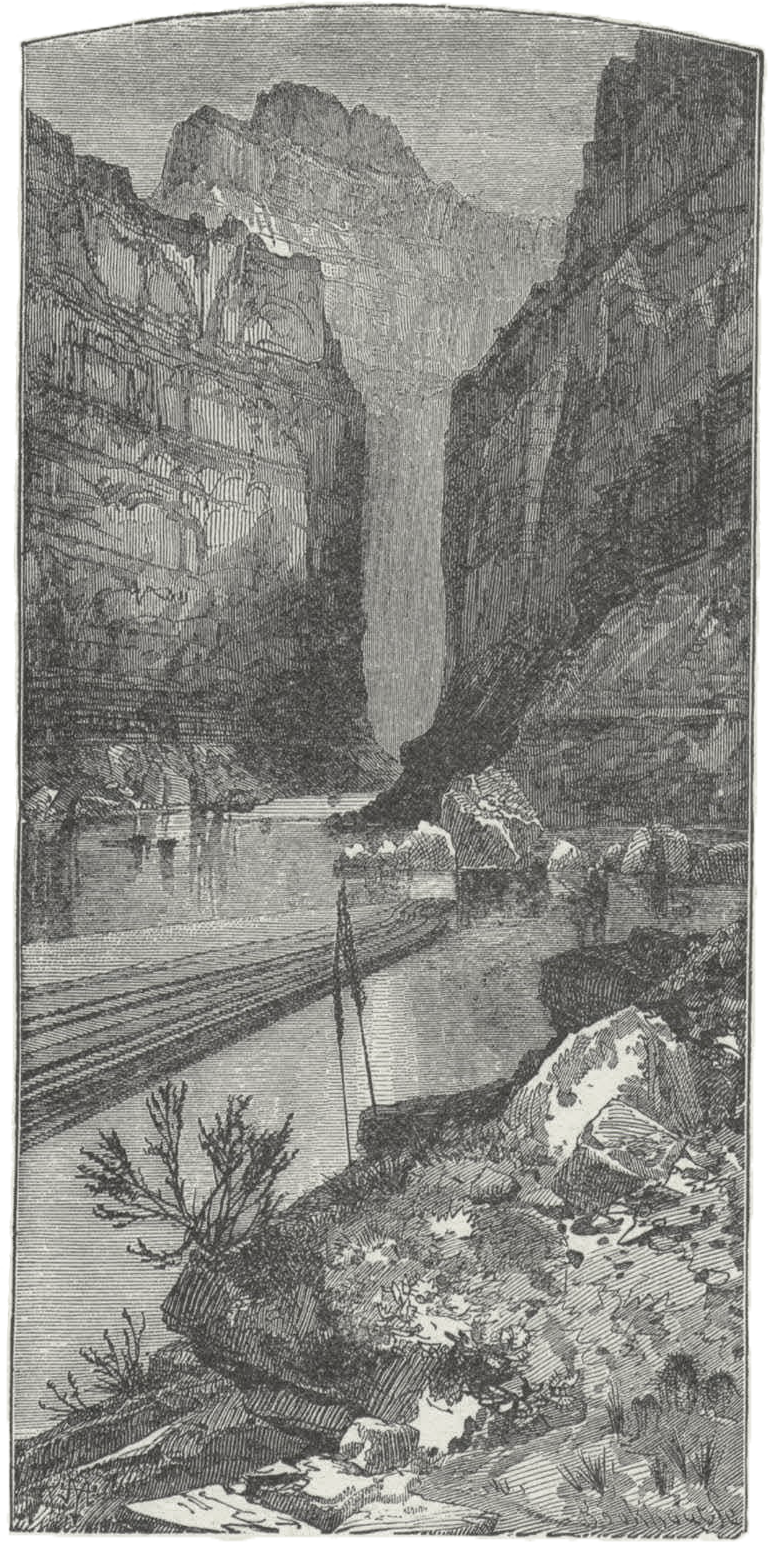
Figure 26—Marble Cañon.
— August 10 —
Walls still higher; water swift again. We pass several
broad, ragged cañons on our right, and up through these we catch
glimpses of a forest–clad plateau, miles away to the west.
At two o’clock we reach the mouth of the Colorado Chiquito. This
stream enters through a cañon on a scale quite as grand as that of the
Colorado itself. It is a very small river and exceedingly muddy and
salt. I walk up the stream three or four miles this afternoon, crossing
and recrossing where I can easily wade it. Then I climb several hundred
feet at one place, and can see for several miles up the chasm
through which the river runs. On my way back I kill two rattlesnakes,
and find on my arrival that another has been killed just at camp.
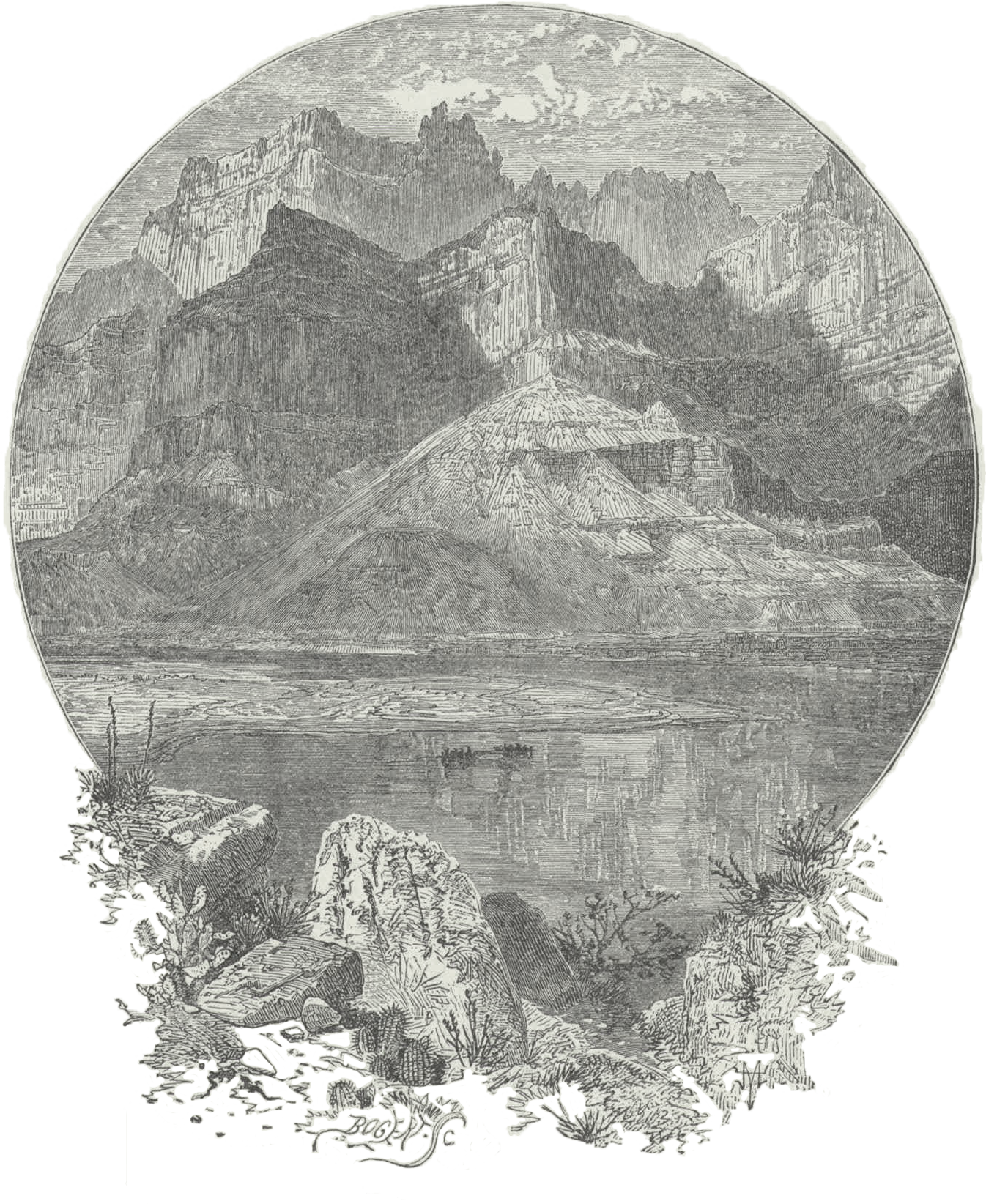
Figure 27—View from camp at the mouth of the Little Colorado, looking west.
— August 11 —
We remain at this point to–day for the purpose of determining the latitude and longitude, measuring the height of the walls,
drying our rations, and repairing our boats.
Captain W.H. Powell early in the morning takes a barometer and goes out
to climb a point between the two rivers.
I walk down the gorge to
the left at the foot of the cliff, climb to a bench, and discover a trail,
deeply worn in the rock. Where it crosses the side gulches in some
places steps have been cut. I can see no evidence of its having been
traveled for a long time. It was doubtless a path used by the people
who inhabited this country anterior to the present Indian races—the
people who built the communal houses of which mention has been made.
I return to camp about three o’clock and find that some of the men
have discovered ruins and many fragments of pottery; also etchings and
hieroglyphics on the rocks.
We find to–night, on comparing the readings of the barometers, that
the walls are about 3,000 feet high—more than half a mile—an altitude
difficult to appreciate from a mere statement of feet. The slope by
which the ascent is made is not such a slope as is usually found in
climbing a mountain, but one much more abrupt—often vertical for
many hundreds of feet—so that the impression is given that we are
at great depths, and we look up to see but a little patch of sky.
Between the two streams, above the Colorado Chiquito, in some places
the rocks are broken and shelving for six or seven hundred feet; then there
is a sloping terrace, which can be climbed only by finding some way up
a gulch; then another terrace, and back, still another cliff. The summit
of the cliff is 3,000 feet above the river, as our barometers attest.
Our camp is below the Colorado Chiquito and on the eastern side of
the cañon.
The rocks above camp are rust–colored sandstones and
conglomerates. Some are very hard; others quite soft. They all lie
nearly horizontal, and the beds of softer material have been washed out,
leaving the harder forming a series of shelves. Long lines of these
are seen, of varying thickness, from one or two to twenty or thirty feet,
and the spaces between have the same variability.
This morning I
spend two or three hours in climbing among these shelves, and then
I pass above them and go up a long slope to the foot of the cliff and try
to discover some way by which I can reach the top of the wall; but
I find my progress cut off by an amphitheater. Then I wander away
around to the left, up a little gulch and along benches, climbing from
time to time, until I reach an altitude of nearly 2,000 feet and can
get no higher.
From this point I can look off to the west, up side
cañons of the Colorado, and see the edge of a great plateau, from
which streams run down into the Colorado, and deep gulches in the
escarpment which faces us, continued by cañons, ragged and flaring and
set with cliffs and towering crags, down to the river. I can see far
up Marble Cañon to long lines of chocolate–colored cliffs, and above
these the Vermilion Cliffs. I can see, also, up the Colorado Chiquito,
through a very ragged and broken cañon, with sharp salients set
out from the walls on either side, their points overlapping, so that
a huge tooth of marble on one side seems to be set between two teeth on
the opposite; and I can also get glimpses of walls standing away back
from the river, while over my head are mural escarpments not possible
to be scaled.
Cataract Cañon is 41 miles long. The walls are 1,300 feet high at
its head, and they gradually increase in altitude to a point about
halfway down, where they are 2,700 feet, and then decrease to 1,300 feet
at the foot. Narrow Cañon is nine and a half miles long, with walls 1,300 feet
in height at the head and coming down to the water at the foot.
There is very little vegetation in this cañon or in the adjacent
country. Just at the junction of the Grand and Green there are a
number of hackberry trees; and along the entire length of Cataract
Cañon the high–water line is marked by scattered trees of the same
species. A few nut pines and cedars are found, and occasionally a
redbud or Judas tree; but the general aspect of the cañons and of the
adjacent country is that of naked rock.
The distance through Glen Cañon is 149 miles. Its walls vary in
height from 200 or 300 to 1,600 feet.
Marble Cañon is 65½ miles long.
At its head it is 200 feet deep, and it steadily increases in depth to
its foot, where its walls are 3,500 feet high.
We are now ready to start on our way down the
Great Unknown. Our boats, tied to a common stake, chafe
each other as they are tossed by the fretful river. They ride
high and buoyant, for their loads are lighter than we could desire. We
have but a month’s rations remaining. The flour has been resifted
through the mosquito–net sieve; the spoiled bacon has been dried and
the worst of it boiled; the few pounds of dried apples have been spread
in the sun and reshrunken to their normal bulk. The sugar has all
melted and gone on its way down the river. But we have a large sack of
coffee. The lightening of the boats has this advantage: they will ride
the waves better and we shall have but little to carry when we make a
portage.
We are three quarters of a mile in the depths of the earth, and
the great river shrinks into insignificance as it dashes its angry waves
against the walls and cliffs that rise to the world above; the waves are
but puny ripples, and we but pigmies, running up and down the sands
or lost among the boulders.
We have an unknown distance yet to run, an unknown river to explore.
What falls there are, we know not; what rocks beset the channel,
we know not; what walls rise over the river, we know not. Ah, well!
We may conjecture many things. The men talk as cheerfully as ever;
jests are bandied about freely this morning; but to me the cheer is
somber and the jests are ghastly.
With some eagerness and some anxiety and some misgiving we enter
the cañon below and are carried along by the swift water through walls
which rise from its very edge. They have the same structure that we
noticed yesterday—tiers of irregular shelves below, and, above these,
steep slopes to the foot of marble cliffs. We run six miles in a little
more than half an hour and emerge into a more open portion of the
cañon, where high hills and ledges of rock intervene between the river
and the distant walls. Just at the head of this open place the river runs
across a dike; that is, a fissure in the rocks, open to depths below, was
filled with eruptive matter, and this on cooling was harder than the
rocks through which the crevice was made, and when these were washed
away the harder volcanic matter remained as a wall, and the river has
cut a gateway through it several hundred feet high and as many wide.
As it crosses the wall, there is a fall below and a bad rapid, filled with
boulders of trap; so we stop to make a portage. Then on we go, gliding
by hills and ledges, with distant walls in view; sweeping past sharp
angles of rock; stopping at a few points to examine rapids, which we
find can be run, until we have made another five miles, when we land for
dinner.
Then we let down with lines over a long rapid and start again. Once
more the walls close in, and we find ourselves in a narrow gorge, the
water again filling the channel and being very swift. With great care
and constant watchfulness we proceed, making about four miles this
afternoon, and camp in a cave.
At daybreak we walk down the bank of the river, on
a little sandy beach, to take a view of a new feature in the cañon.
Heretofore hard rocks have given us bad river; soft rocks, smooth
water; and a series of rocks harder than any we have experienced sets
in. The river enters the granite! (Geologists would call these rocks metamorphic
crystalline schists, with dikes and beds of granite, but we will use the popular name for the whole series granite.)
We can see but a little way into the
granite gorge, but it looks threatening.
After breakfast we enter on the waves. At the very introduction
it inspires awe. The cañon is narrower than we have ever before seen
it; the water is swifter; there are but few broken rocks in the channel;
but the walls are set, on either side, with pinnacles and crags; and
sharp, angular buttresses, bristling with wind– and wave–polished spires,
extend far out into the river.
Ledges of rock jut into the stream, their tops sometimes just below
the surface, sometimes rising a few or many feet above; and island ledges
and island pinnacles and island towers break the swift course of the
stream into chutes and eddies and whirlpools. We soon reach a place
where a creek comes in from the left, and, just below, the channel is
choked with boulders, which have washed down this lateral cañon and
formed a dam, over which there is a fall of 30 or 40 feet; but on the
boulders foothold can be had, and we make a portage.
Three more such dams are found. Over one we make a portage; at the other two are
chutes through which we can run.
As we proceed the granite rises higher, until nearly a thousand feet of
the lower part of the walls are composed of this rock.
About eleven o’clock we hear a great roar ahead, and approach it very
cautiously. The sound grows louder and louder as we run, and at last
we find ourselves above a long, broken fall, with ledges and pinnacles of
rock obstructing the river. There is a descent of perhaps 75 or 80 feet
in a third of a mile, and the rushing waters break into great waves
on the rocks, and lash themselves into a mad, white foam. We can
land just above, but there is no foothold on either side by which we can
make a portage. It is nearly a thousand feet to the top of the granite
so it will be impossible to carry our boats around, though, we can
climb to the summit up a side gulch and, passing along a mile or two,
descend to the river. This we find on examination; but such a portage
would be impracticable for us, and we must run the rapid or abandon the
river.
There is no hesitation. We step into our boats, push off, and
away we go, first on smooth but swift water, then we strike a glassy
wave and ride to its top, down again into the trough, up again on a
higher wave, and down and up on waves higher and still higher until we
strike one just as it curls back, and a breaker rolls over our little boat.
Still on we speed, shooting past projecting rocks, till the little boat
is caught in a whirlpool and spun round several times. At last we pull
out again into the stream. And now the other boats have passed us.
The open compartment of the ‘Emma Dean’ is filled with water and
every breaker rolls over us. Hurled back from a rock, now on this side,
now on that, we are carried into an eddy, in which we struggle for a few
minutes, and are then out again, the breakers still rolling over us. Our
boat is unmanageable, but she cannot sink, and we drift down another
hundred yards through breakers—how, we scarcely know. We find the
other boats have turned into an eddy at the foot of the fall and are waiting to catch us as we come, for the men have seen that our boat is
swamped. They push out as we come near and pull us in against the
wall. Our boat bailed, on we go again.
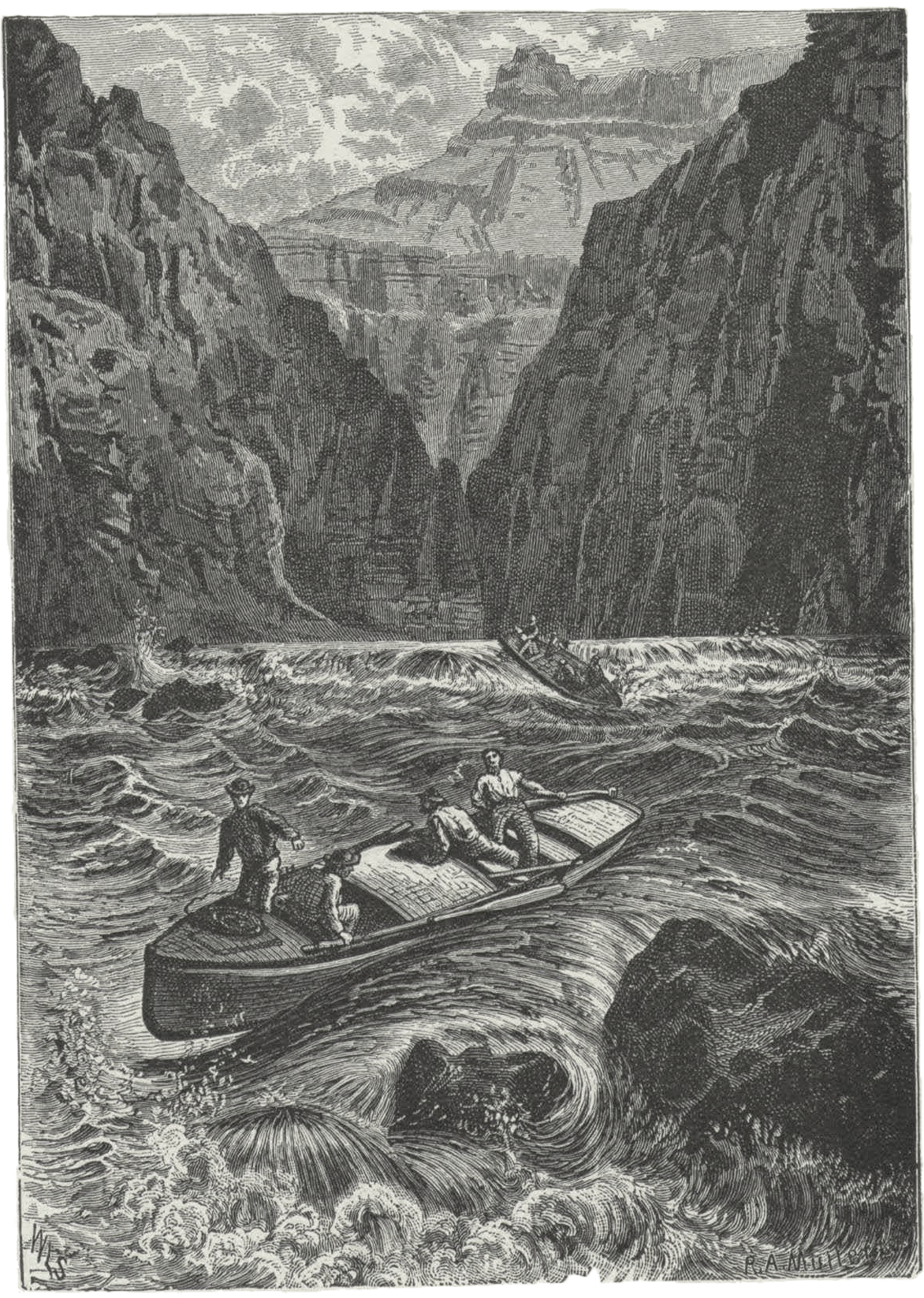
Figure 28—Running a rapid.
The walls now are more than a mile in height—a vertical distance
difficult to appreciate. Stand on the south steps of the Treasury building
in Washington and look down Pennsylvania Avenue to the Capitol;
measure this distance overhead, and imagine cliffs to extend to that altitude,
and you will understand what is meant; or stand at Canal Street in
New York and look up Broadway to Grace Church, and you have about
the distance; or stand at Lake Street bridge in Chicago and look down
to the Central Depot, and you have it again.
A thousand feet of this is up through granite crags; then steep slopes
and perpendicular cliffs rise one above another to the summit. The
gorge is black and narrow below, red and gray and flaring above, with
crags and angular projections on the walls, which, cut in many places by
side cañons, seem to be a vast wilderness of rocks. Down in these
grand, gloomy depths we glide, ever listening, for the mad waters keep
up their roar; ever watching, ever peering ahead, for the narrow cañon
is winding and the river is closed in so that we can see but a few hundred
yards, and what there may be below we know not; so we listen for
falls and watch for rocks, stopping now and then in the bay of a recess
to admire the gigantic scenery; and ever as we go there is some new
pinnacle or tower, some crag or peak, some distant view of the upper
plateau, some strangely shaped rock, or some deep, narrow side cañon.
Then we come to another broken fall, which appears more difficult
than the one we ran this morning. A small creek comes in on the right,
and the first fall of the water is over boulders, which have been carried
down by this lateral stream. We land at its mouth and stop for an hour
or two to examine the fall. It seems possible to let down with lines, at
least a part of the way, from point to point, along the right–hand wall.
So we make a portage over the first rocks and find footing on some
boulders below. Then we let down one of the boats to the end of her
line, when she reaches a corner of the projecting rock, to which one
of the men clings and steadies her while I examine an eddy below.
I think we can pass the other boats down by us and catch them in the
eddy.
This is soon done, and the men in the boats in the eddy pull us
to their side. On the shore of this little eddy there is about two feet of
gravel beach above the water. Standing on this beach, some of the men
take the line of the little boat and let it drift down against another
projecting angle. Here is a little shelf, on which a man from my boat
climbs, and a shorter line is passed to him, and he fastens the boat
to the side of the cliff; then the second one is let down, bringing
the line of the third. When the second boat is tied up, the two men
standing on the beach above spring into the last boat, which is pulled up
alongside of ours; then we let down the boats for 25 or 30 yards by
walking along the shelf, landing them again in the, mouth of a side
cañon. Just below this there is another pile of boulders, over which
we make another portage. From the foot of these rocks we can climb
to another shelf, 40 or 50 feet above the water.
On this bench we camp for the night. It is raining hard, and we
have no shelter, but find a few sticks which have lodged in the rocks,
and kindle a fire and have supper. We sit on the rocks all night,
wrapped in our ponchos, getting what sleep we can.
This morning we find we can let down for 300 or 400
yards, and it is managed in this way: we pass along the wall by climbing
from projecting point to point, sometimes near the water’s edge, at
other places 50 or 60 feet above, and hold the boat with a line while two
men remain aboard and prevent her from being dashed against the
rocks and keep the line from getting caught on the wall. In two
hours we have brought them all down, as far as it is possible, in this
way. A few yards below, the river strikes with great violence against a
projecting rock and our boats are pulled up in a little bay above. We
must now manage to pull out of this and clear the point below. The
little boat is held by the bow obliquely up the stream. We jump in
and pull out only a few strokes, and sweep clear of the dangerous rock.
The other boats follow in the same manner and the rapid is passed.
It is not easy to describe the labor of such navigation. We must prevent
the waves from dashing the boats against the cliffs. Sometimes,
where the river is swift, we must put a bight of rope about a rock,
to prevent the boat from being snatched from us by a wave; but where
the plunge is too great or the chute too swift, we must let her leap and
catch her below or the undertow will drag her under the falling water
and sink her. Where we wish to run her out a little way from shore
through a channel between rocks, we first throw in little sticks of driftwood
and watch their course, to see where we must steer so that she will
pass the channel in safety. And so we hold, and let go, and pull, and
lift, and ward—among rocks, around rocks, and over rocks.
And now we go on through this solemn, mysterious way. The river is
very deep, the cañon very narrow, and still obstructed, so that there is
no steady flow of the stream; but the waters reel and roll and boil, and
we are scarcely able to determine where we can go. Now the boat
is carried to the right, perhaps close to the wall; again, she is shot into
the stream, and perhaps is dragged over to the other side, where, caught
in a whirlpool, she spins about. We can neither land nor run as we
please. The boats are entirely unmanageable; no order in their running
can be preserved; now one, now another, is ahead, each crew laboring
for its own preservation. In such a place we come to another rapid.
Two of the boats run it perforce. One succeeds in landing, but there is
the stream. The next minute a great reflex wave fills the open compartment;
she is water–logged, and drifts unmanageable. Breaker after
breaker rolls over her and one capsizes her. The men are thrown out;
but they cling to the boat, and she drifts down some distance alongside
of us and we are able to catch her. She is soon bailed out and the men
are aboard once more; but the oars are lost, and so a pair from the
‘Emma Dean’ is spared. Then for two miles we find smooth water.
Clouds are playing in the cañon to–day. Sometimes they roll down
in great masses, filling the gorge with gloom; sometimes they hang
aloft from wall to wall and cover the cañon with a roof of impending
storm, and we can peer long distances up and down this cañon corridor,
with its cloud–roof overhead, its walls of black granite, and
its river bright with the sheen of broken waters. Then a gust of wind
sweeps down a side gulch and, making a rift in the clouds, reveals the
blue heavens, and a stream of sunlight pours in. Then the clouds drift
away into the distance, and hang around crags and peaks and pinnacles
and towers and walls, and cover them with a mantle that lifts from time
to time and sets them all in sharp relief. Then baby clouds creep out of
side cañons, glide around points, and creep back again into more distant
gorges. Then clouds arrange in strata across the cañon, with
intervening vista views to cliffs and rocks beyond. The clouds are
children of the heavens, and when they play among the rocks they lift
them to the region above.
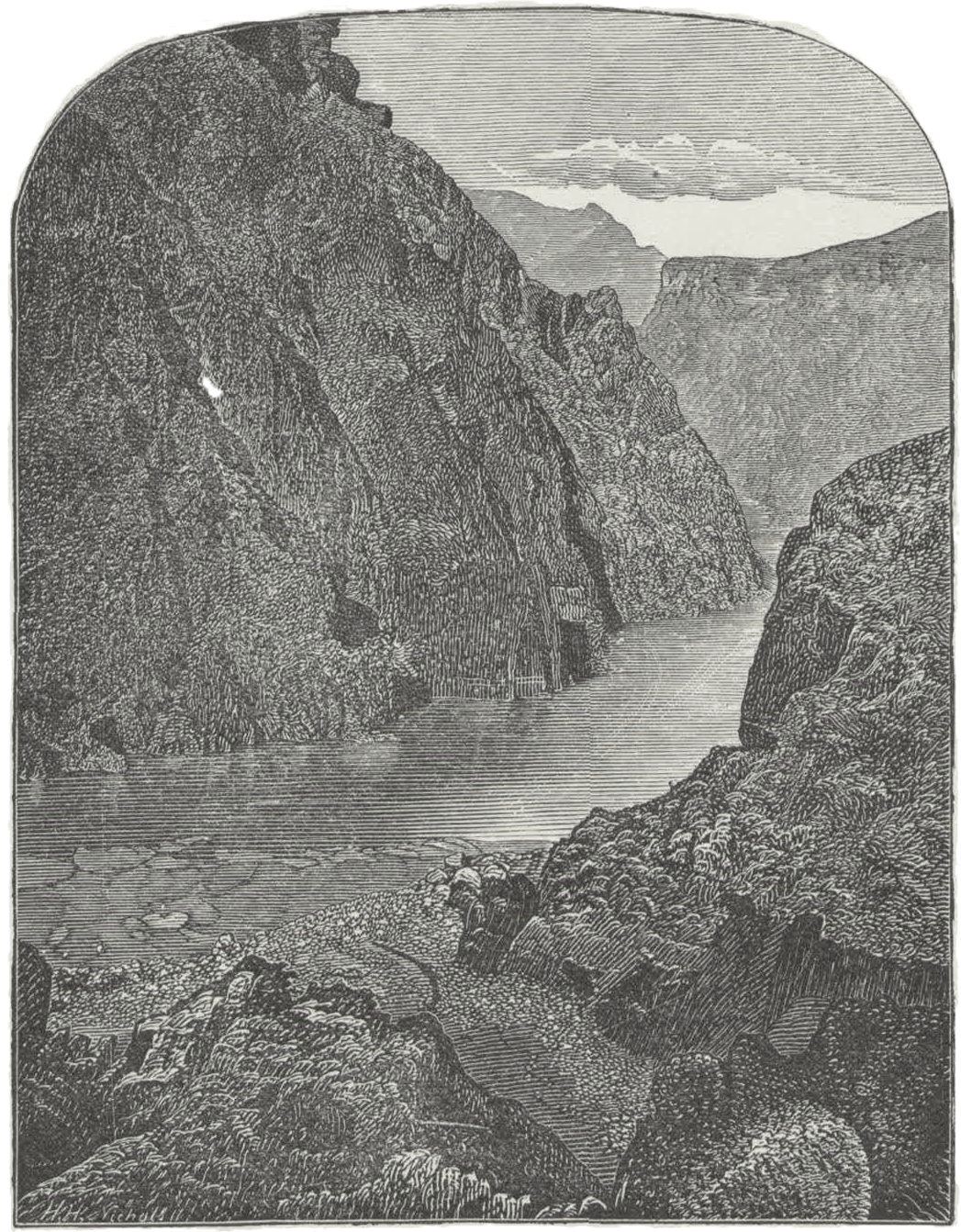
Figure 29—Granite Walls.
It rains! Rapidly little rills are formed above, and these soon grow
into brooks, and the brooks grow into creeks and tumble over the walls
in innumerable cascades, adding their wild music to the roar of the
river. When the rain ceases the rills, brooks, and creeks run dry. The
waters that fall during a rain on these steep rocks are gathered at once
into the river; they could scarcely be poured in more suddenly if some
vast spout ran from the clouds to the stream itself. When a storm bursts
over the cañon a side gulch is dangerous, for a sudden flood may come,
and the inpouring waters will raise the river so as to hide the rocks.
Early in the afternoon we discover a stream entering from the north—a clear, beautiful creek, coming down through a gorgeous red cañon.
We land and camp on a sand beach above its mouth, under a great,
overspreading tree with willow–shaped leaves.
We must dry our rations again to–day and make oars.
The Colorado is never a clear stream, but for the past three or four
days it has been raining much of the time, and the floods poured over
the walls have brought down great quantities of mud, making it exceedingly
turbid now. The little affluent which we have discovered here is a
clear, beautiful creek, or river, as it would be termed in this western
country, where streams are not abundant. We have named one stream,
away above, in honor of the great chief of the ‘Bad Angels,’ and, as
this is in beautiful contrast to that, we conclude to name it ‘Bright
Angel.’
Early in the morning the whole party starts up to explore the Bright
Angel River, with the special purpose of seeking timber from which to
make oars. A couple of miles above we find a large pine log, which has
been floated down from the plateau, probably from an altitude of more
than 6,000 feet, but not many miles back. On its way it must have
passed over many cataracts and falls, for it bears scars in evidence of the
rough usage which it has received. The men roll it on skids, and the
work of sawing oars is commenced.
This stream heads away back under a line of abrupt cliffs that terminates
the plateau, and tumbles down more than 4,000 feet in the first
mile or two of its course; then runs through a deep, narrow cañon
until it reaches the river.
Late in the afternoon I return and go up a little gulch just above
this creek, about 200 yards from camp, and discover the ruins of two
or three old houses, which were originally of stone laid in mortar. Only
the foundations are left, but irregular blocks, of which the houses were
constructed, lie scattered about. In one room I find an old mealing stone,
deeply worn, as if it had been much used. A great deal of pottery is strewn
around, and old trails, which in some places are deeply
worn into the rocks, are seen.
It is ever a source of wonder to us why these ancient people sought
such inaccessible places for their homes. They were, doubtless, an
agricultural race, but there are no lands here of any considerable extent
that they could have cultivated. To the west of Oraibi, one of the
towns in the Province of Tusayan, in northern Arizona, the inhabitants
have actually built little terraces along the face of the cliff where a
spring gushes out, and thus made their sites for gardens. It is possible
that the ancient inhabitants of this place made their agricultural lands in
the same way.
But why should they seek such spots? Surely the
country was not so crowded with people as to demand the utilization
of so barren a region. The only solution suggested of the problem
is this: We know that for a century or two after the settlement of
Mexico many expeditions were sent into the country now comprising
Arizona and New Mexico, for the purpose of bringing the town–building
people under the dominion of the Spanish government. Many of their
villages were destroyed, and the inhabitants fled to regions at that time
unknown; and there are traditions among the people who inhabit the
pueblos that still remain that the cañons were these unknown lands. It
may be these buildings were erected at that time; sure it is that they
have a much more modern appearance than the ruins scattered over
Nevada, Utah, Colorado, Arizona, and New Mexico.
Those old Spanish
conquerors had a monstrous greed for gold and a wonderful lust for
saving souls. Treasures they must have, if not on earth, why, then, in
heaven; and when they failed to find heathen temples bedecked with
silver, they propitiated Heaven by seizing the heathen themselves.
There is yet extant a copy of a record made by a heathen artist to
express his conception of the demands of the conquerors. In one part
of the picture we have a lake, and near by stands a priest pouring water
on the head of a native. On the other side, a poor Indian has a cord
about his throat. Lines run from these two groups to a central figure, a
man with beard and full Spanish panoply. The interpretation of the
picture–writing is this: “Be baptized as this saved heathen, or be
hanged as that damned heathen.” Doubtless, some of these people preferred
another alternative, and rather than be baptized or hanged they
chose to imprison themselves within these cañon walls.
Our rations are still spoiling; the bacon is so badly
injured that we are compelled to throw it away. By an accident, this
morning, the saleratus was lost overboard. We have now only musty
flour sufficient for ten days and a few dried apples, but plenty of coffee.
We must make all haste possible. If we meet with difficulties such as
we have encountered in the cañon above, we may be compelled to give
up the expedition and try to reach the Mormon settlements to the north.
Our hopes are that the worst places are passed, but our barometers are
all so much injured as to be useless, and so we have lost our reckoning
in altitude, and know not how much descent the river has yet to make.
The stream is still wild and rapid and rolls through a narrow channel.
We make but slow progress, often landing against a wall and climbing
around some point to see the river below. Although very anxious to advance,
we are determined to run with great caution, lest by another
accident we lose our remaining supplies. How precious that little
flour has become! We divide it among the boats and carefully store it
away, so that it can be lost only by the loss of the boat itself.
We make ten miles and a half, and camp among the rocks on the
right. We have had rain from time to time all day, and have been
thoroughly drenched and chilled; but between showers the sun shines
with great power and the mercury in our thermometers stands at 115°, so
that we have rapid changes from great extremes, which are very disagreeable.
It is especially cold in the rain to–night. The little canvas
we have is rotten and useless; the rubber ponchos with which we started
from Green River City have all been lost; more than half the party are
without hats, not one of us has an entire suit of clothes, and we have
not a blanket apiece. So we gather driftwood and build a fire; but after
supper the rain, coming down in torrents, extinguishes it, and we sit up
all night on the rocks, shivering, and are more exhausted by the night’s
discomfort than by the day’s toil.
The day is employed in making portages and we advance
but two miles on our journey. Still it rains.
While the men are at work making portages I climb up the granite to
its summit and go away back over the rust–colored sandstones and
greenish–yellow shales to the foot of the marble wall. I climb so high
that the men and boats are lost in the black depths below and the dashing
river is a rippling brook, and still there is more cañon above than
below. All about me are interesting geologic records. The book is
open and I can read as I run. All about me are grand views, too, for
the clouds are playing again in the gorges. But somehow I think of
the nine days’ rations and the bad river, and the lesson of the rocks and
the glory of the scene are but half seen.
I push on to an angle, where I hope to get a view of the country
beyond, to see if possible what the prospect may be of our soon running
through this plateau, or at least of meeting with some geologic change
that will let us out of the granite; but, arriving at the point, I can see
below only a labyrinth of black gorges.
Rain again this morning. We are in our granite prison
still, and the time until noon is occupied in making a long, bad portage.
After dinner, in running a rapid the pioneer boat is upset by a wave.
We are some distance in advance of the larger boats. The river is
rough and swift and we are unable to land, but cling to the boat and are
carried down stream over another rapid. The men in the boats above
see our trouble, but they are caught in whirlpools and are spinning
about in eddies, and it seems a long time before they come to our relief.
At last they do come; our boat is turned right side up and bailed out;
the oars, which fortunately have floated along in company with us, are
gathered up, and on we go, without even landing. Soon after the incident the clouds break away and we have sunshine again.
Soon we find a little beach with just room enough to land. Here we
camp, but there is no wood. Across the river and a little way above,
we see some driftwood lodged in the rocks. So we bring two boat
loads over, build a huge fire, and spread everything to dry. It is the
first cheerful night we have had for a week—a warm, drying fire in the
midst of the camp, and a few bright stars in our patch of heavens overhead.
The characteristics of the cañon change this morning.
The river is broader, the walls more sloping, and composed of black
slates that stand on edge. These nearly vertical slates are washed out in
places—that is, the softer beds are washed out between the harder,
which are left standing. In this way curious little alcoves are formed,
in which are quiet bays of water, but on a much smaller scale than
the great bays and buttresses of Marble Cañon.
The river is still rapid and we stop to let down with lines several
times, but make greater progress, as we run ten miles. We camp on the
right bank. Here, on a terrace of trap, we discover another group of
ruins. There was evidently quite a village on this rock. Again we find
mealing stones and much broken pottery, and up on a little natural shelf
in the rock back of the ruins we find a globular basket that would hold
perhaps a third of a bushel. It is badly broken, and as I attempt to
take it up it falls to pieces. There are many beautiful flint chips, also,
as if this had been the home of an old arrow maker.
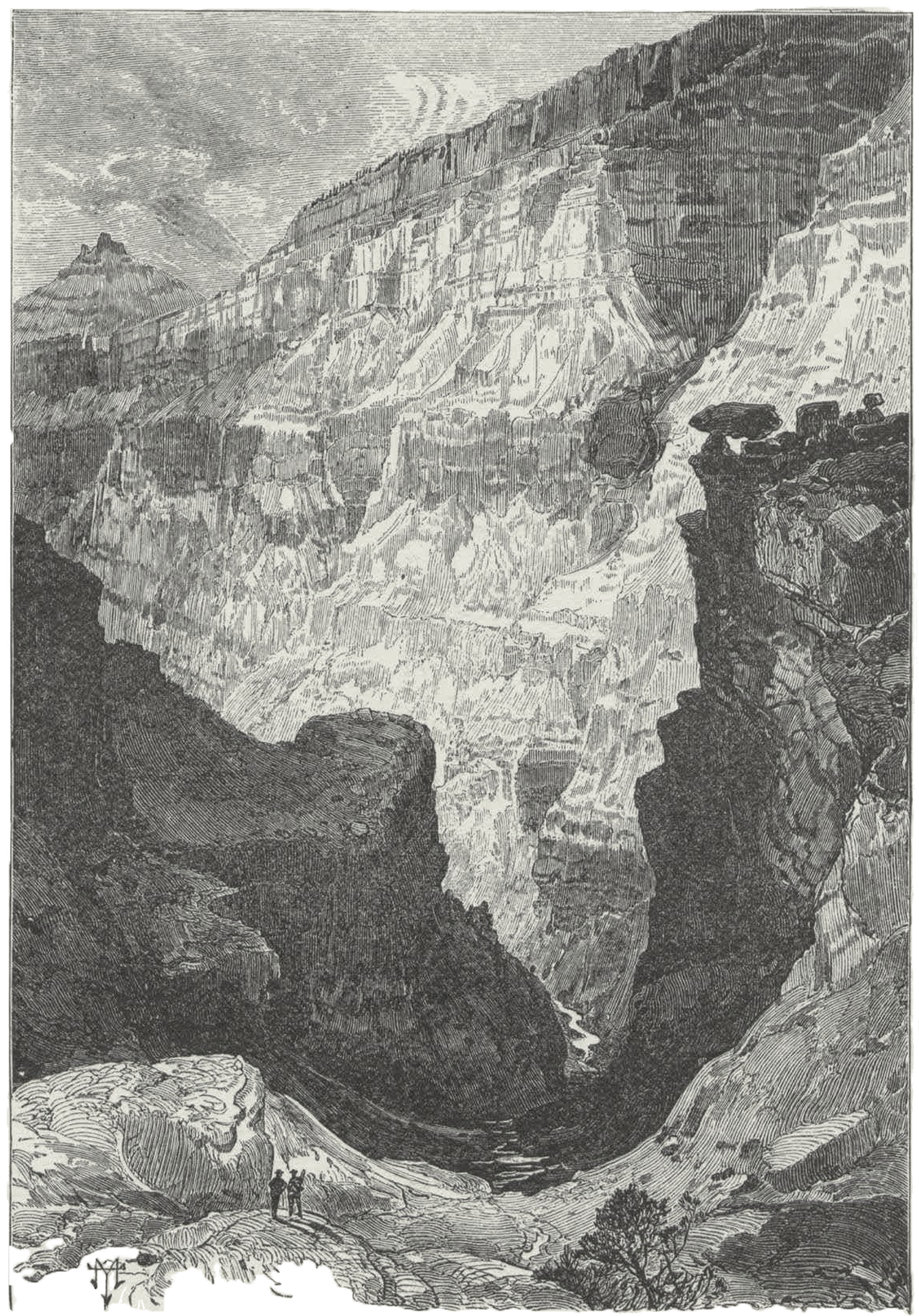
Figure 30—Mu′–av Cañon.
— August 21 —
We start early this morning, cheered by the prospect of a
fine day and encouraged also by the good run made yesterday. A quarter
of a mile below camp the river turns abruptly to the left, and between
camp and that point is very swift, running down in a long, broken chute
and piling up against the foot of the cliff, where it turns to the left. We
try to pull across, so as to go down on the other side, but the waters are
swift and it seems impossible for us to escape the rock below; but, in
pulling across, the bow of the boat is turned to the farther shore, so that
we are swept broadside down and are prevented by the rebounding
waters from striking against the wall. We toss about for a few seconds
in these billows and are then carried past the danger.
Below, the
river turns again to the right, the cañon is very narrow, and we see in
advance but a short distance. The water, too, is very swift, and there is
no landing–place. From around this curve there comes a mad roar, and
down we are carried with a dizzying velocity to the head of another
rapid. On either side high over our heads there are overhanging granite
walls, and the sharp bends cut off our view, so that a few minutes
will carry us into unknown waters. Away we go on one long, winding
chute. I stand on deck, supporting myself with a strap fastened on
either side of the gunwale. The boat glides rapidly where the water is
smooth, then, striking a wave, she leaps and bounds like a thing of life,
and we have a wild, exhilarating ride for ten miles, which we make in
less than an hour.
The excitement is so great that we forget the danger
until we hear the roar of a great fall below; then we back on our oars
and are carried slowly toward its head and succeed in landing just
above and find that we have to make another portage. At this we are
engaged until some time after dinner.
Just here we run out of the granite.
Ten miles in less than half a day,
and limestone walls below. Good cheer returns; we forget the storms
and the gloom and the cloud–covered cañons and the black granite and
the raging river, and push our boats from shore in great glee.
Though we are out of the granite, the river is still swift, and we wheel
about a point again to the right, and turn, so as to head back in the
direction from which we came; this brings the granite in sight again,
with its narrow gorge and black crags; but we meet with no more great
falls or rapids. Still, we run cautiously and stop from time to time to
examine some places which look bad. Yet we make ten miles this
afternoon; twenty miles in all to–day.
We come to rapids again this morning and are occupied
several hours in passing them, letting the boats down from rock to rock
with lines for nearly half a mile, and then have to make a long portage.
While the men are engaged in this I climb the wall on the northeast to a
height of about 2,500 feet, where I can obtain a good view of a long
stretch of cañon below. Its course is to the southwest. The walls
seem to rise very abruptly for 2,500 or 3,000 feet, and then there is a
gently sloping terrace on each side for two or three miles, when we again
find cliffs, 1,500 or 2,000 feet high. From the brink of these the plateau
stretches back to the north and south for a long distance. Away down
the cañon on the right wall I can see a group of mountains, some of
which appear to stand on the brink of the cañon. The effect of the
terrace is to give the appearance of a narrow winding valley with high
walls on either side and a deep, dark, meandering gorge down its
middle. It is impossible from this point of view to determine whether
or not we have granite at the bottom; but from geologic considerations,
I conclude that we shall have marble walls below.
After my return to the boats we run another mile and camp for the
night. We have made but little over seven miles to–day, and a part of
our flour has been soaked in the river again.
Our way to–day is again through marble walls. Now and then we pass for a short distance through patches of granite, like hills thrust up into the limestone. At one of these places we have to make another portage, and, taking advantage of the delay, I go up a little stream to the north, wading it all the way, sometimes having to plunge in to my neck, in other places being compelled to swim across little basins that have been excavated at the foot of the falls. Along its course are many cascades and springs, gushing out from the rocks on either side. Sometimes a cottonwood tree grows over the water. I come to one beautiful fall, of more than 150 feet, and climb around it to the right on the broken rocks. Still going up, the cañon is found to narrow very much, being but 15 or 20 feet wide; yet the walls rise on either side many hundreds of feet, perhaps thousands; I can hardly tell.
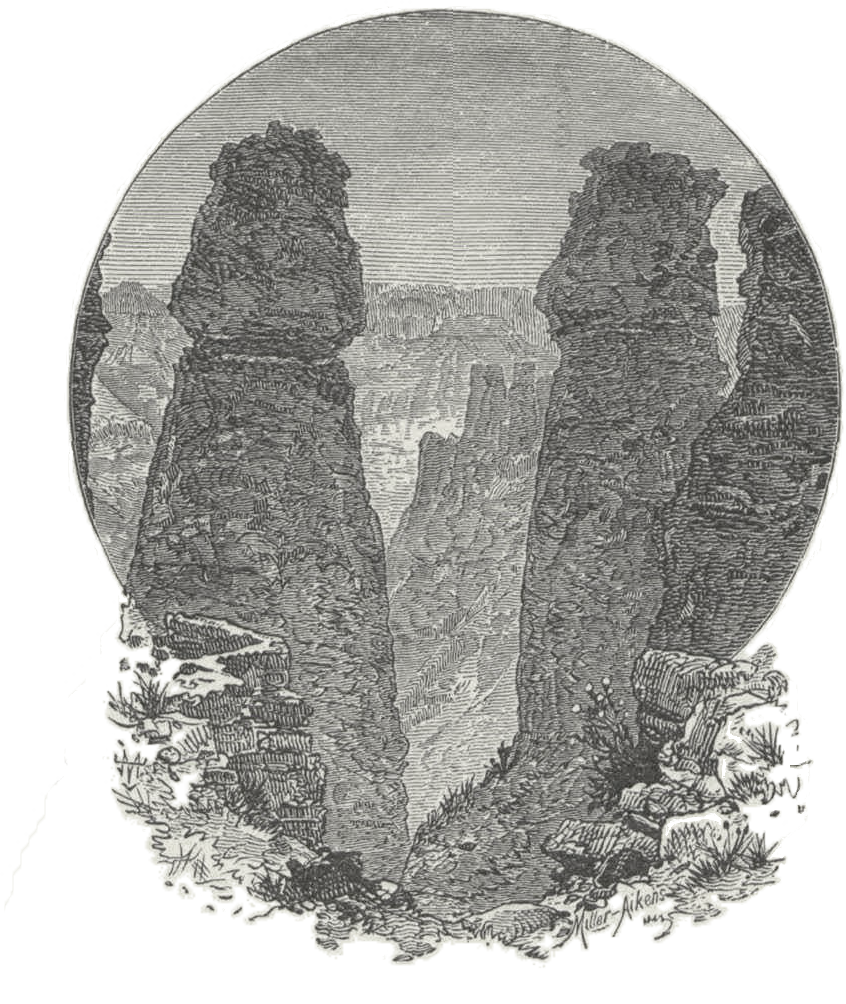
Figure 31—Standing rocks on the brink of Mu′–av Cañon.
In some places the stream has not excavated its channel down vertically
through the rocks, but has cut obliquely, so that one wall overhangs the other. In other places it is cut vertically above and obliquely
below, or obliquely above and vertically below, so that it is impossible to
see out overhead. But I can go no farther; the time which I estimated
it would take to make the portage has almost expired, and I start back
on a round trot, wading in the creek where I must and plunging through
basins. The men are waiting for me, and away we go on the river.
Just after dinner we pass a stream on the right, which leaps into the
Colorado by a direct fall of more than 100 feet, forming a beautiful cascade.
There is a bed of very hard rock above, 30 or 40 feet in thickness,
and there are much softer beds below. The hard beds above project
many yards beyond the softer, which are washed out, forming a deep
cave behind the fall, and the stream pours through a narrow crevice
above into a deep pool below. Around on the rocks in the cavelike
chamber are set beautiful ferns, with delicate fronds and enameled stalks.
The frondlets have their points turned down to form spore cases. It has
very much the appearance of the maidenhair fern, but is much larger.
This delicate foliage covers the rocks all about the fountain, and gives
the chamber great beauty. But we have little time to spend in admiration;
so on we go.
We make fine progress this afternoon, carried along by a swift river,
shooting over the rapids and finding no serious obstructions. The cañon
walls for 2,500 or 3,000 feet are very regular, rising almost perpendicularly,
but here and there set with narrow steps, and occasionally we
can see away above the broad terrace to distant cliffs.
We camp to–night in a marble cave, and find on looking at our reckoning
that we have run 22 miles.
The cañon is wider to–day. The walls rise to a vertical
height of nearly 3,000 feet. In many places the river runs under a cliff
in great curves, forming amphitheaters half–dome shaped.
Though the river is rapid, we meet with no serious obstructions and
run 20 miles. How anxious we are to make up our reckoning every
time we stop, now that our diet is confined to plenty of coffee, a very
little spoiled flour, and very few dried apples! It has come to be a race
for a dinner. Still, we make such fine progress that all hands are in
good cheer, but not a moment of daylight is lost.
We make 12 miles this morning, when we come to monuments of lava standing
in the river—low rocks mostly, but some of them
shafts more than a hundred feet high. Going on down three or four
miles, we find them increasing in number. Great quantities of cooled
lava and many cinder cones are seen on either side; and then we come
to an abrupt cataract. Just over the fall on the right wall a cinder cone,
or extinct volcano, with a well–defined crater, stands on the very brink
of the cañon. This, doubtless, is the one we saw two or three days ago.
From this volcano vast floods of lava have been poured down into the
river, and a stream of molten rock has run up the cañon three or four
miles and down we know not how far. Just where it poured over the
cañon wall is the fall. The whole north side as far as we can see is
lined with the black basalt, and high up on the opposite wall are patches
of the same material, resting on the benches and filling old alcoves and
caves, giving the wall a spotted appearance.
The rocks are broken in two along a line which here crosses the river,
and the beds we have seen while coming down the cañon for the last 30
miles have dropped 800 feet on the lower side of the line, forming what
geologists call a ‘fault.’ The volcanic cone stands directly over the
fissure thus formed. On the left side of the river, opposite, mammoth
springs burst out of this crevice, 100 or 200 feet above the river, pouring
in a stream quite equal in volume to the Colorado Chiquito.
This stream seems to be loaded with carbonate of lime, and the water,
evaporating, leaves an incrustation on the rocks; and this process has
been continued for a long time, for extensive deposits are noticed in
which are basins with bubbling springs. The water is salty.
We have to make a portage here, which is completed in about three
hours; then on we go.
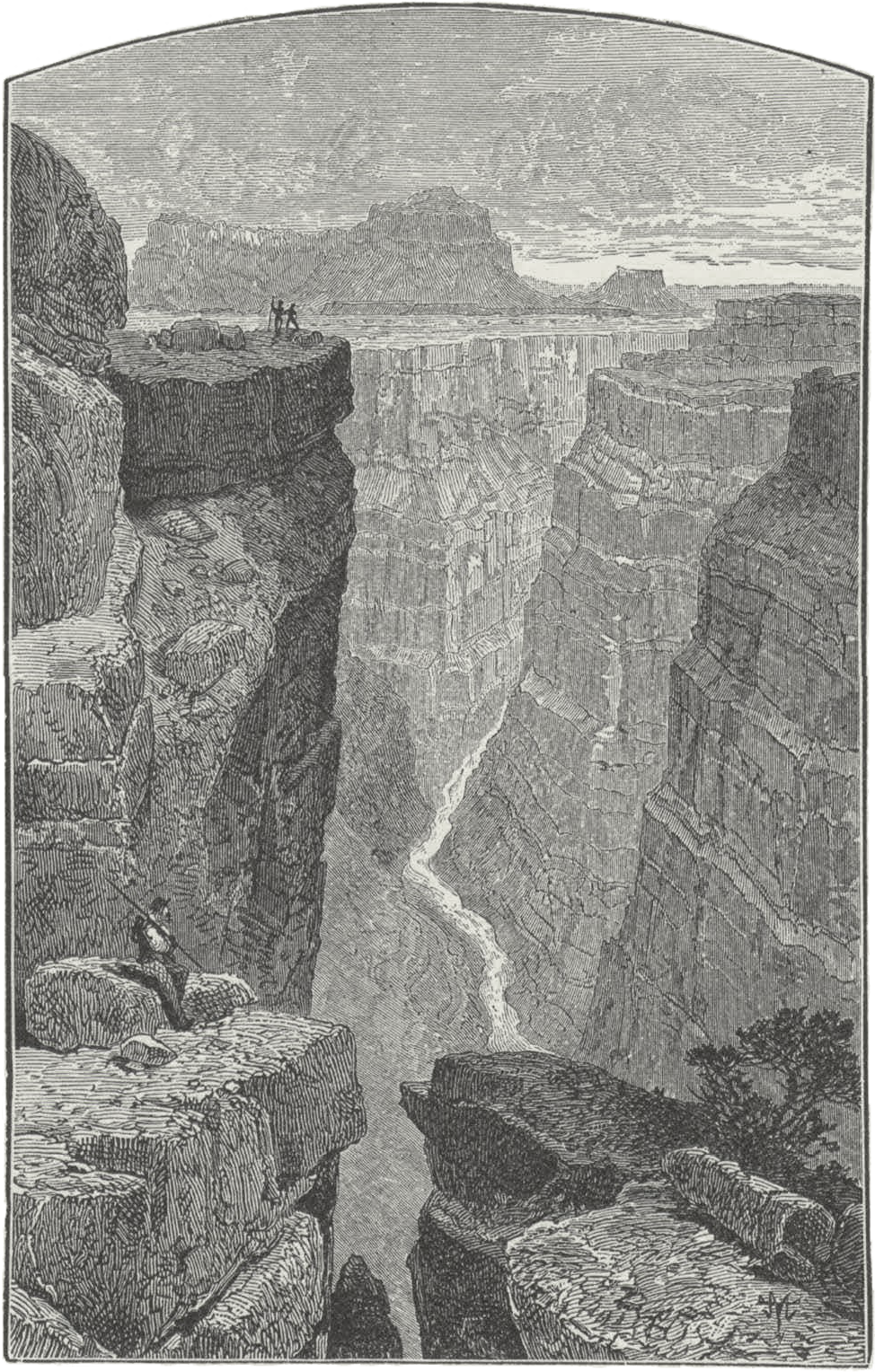
Figure 32—The Grand Cañon, looking east from To ro–weap.
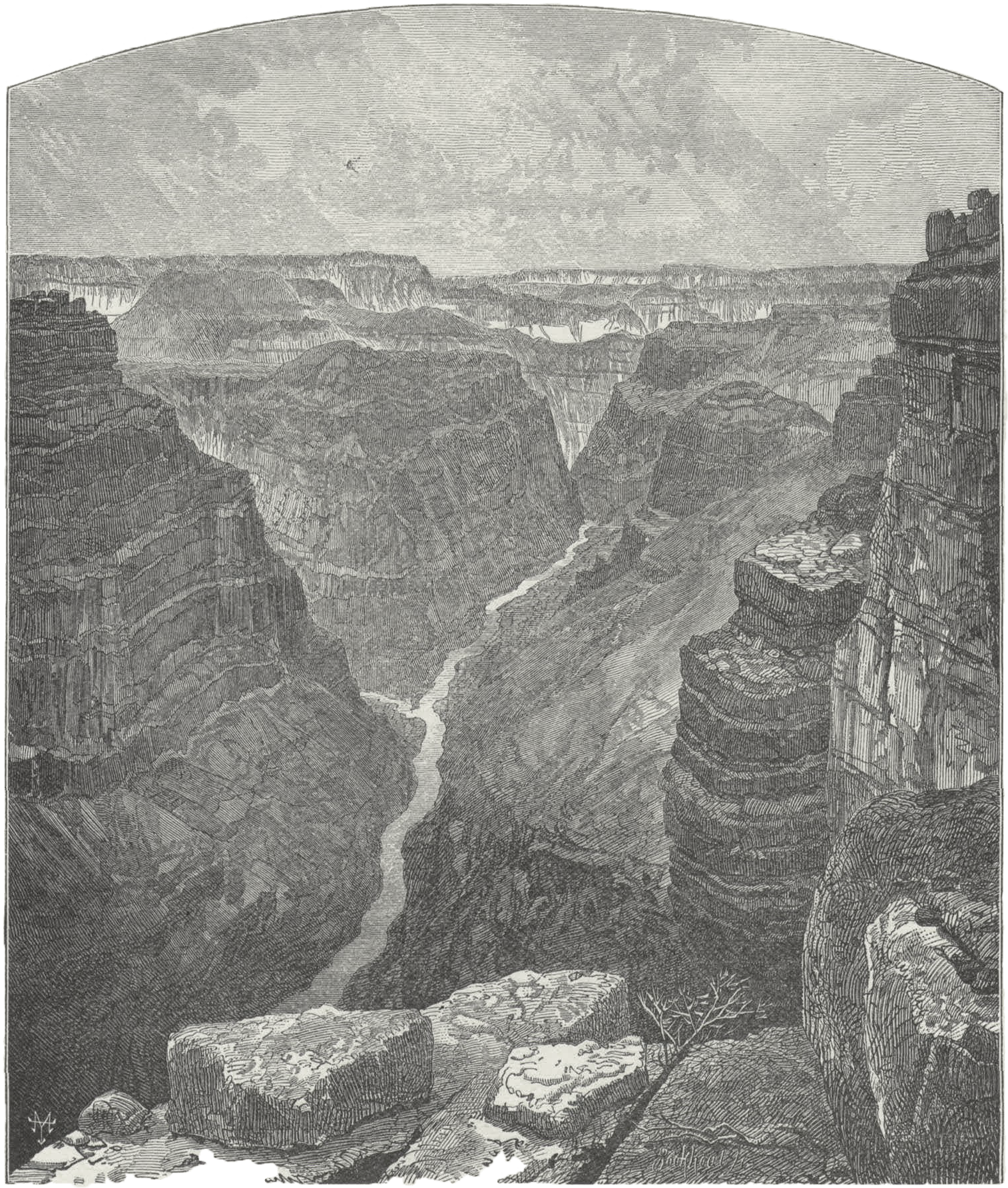
Figure 33—The Grand Cañon, looking west from To ro–weap.
We have no difficulty as we float along, and I am able to observe the
wonderful phenomena connected with this flood of lava. The cañon
was doubtless filled to a height of 1,200 or 1,500 feet, perhaps by more
than one flood. This would dam the water back; and in cutting through
this great lava bed, a new channel has been formed, sometimes on one
side, sometimes on the other. The cooled lava, being of firmer texture
than the rocks of which the walls are composed, remains in some places;
in others a narrow channel has been cut, leaving a line of basalt on
either side. It is possible that the lava cooled faster on the sides against
the walls and that the center ran out; but of this we can only conjecture.
There are other places where almost the whole of the lava is gone, only
patches of it being seen where it has caught on the walls. As we float
down we can see that it ran out into side cañons. In some places this
basalt has a fine, columnar structure, often in concentric prisms, and
masses of these concentric columns have coalesced. In some places, when
the flow occurred the cañon was probably about the same depth that
it is now, for we can see where the basalt has rolled out on the sands,
and—what seems curious to me—the sands are not melted or metamorphosed
to any appreciable extent. In places the bed of the river is of
sandstone or limestone, in other places of lava, showing that it has all
been cut out again where the sandstones and limestones appear; but
there is a little yet left where the bed is of lava.
What a conflict of water and fire there must have been here! Just
imagine a river of molten rock running down into a river of melted snow.
What a seething and boiling of the waters; what clouds of steam rolled
into the heavens!
Thirty five miles to–day. Hurrah!
The cañon walls are steadily becoming higher as we advance.
They are still bold and nearly vertical up to the terrace. We
still see evidence of the eruption discovered yesterday, but the thickness
of the basalt is decreasing as we go down stream; yet it has been
reinforced at points by streams that have come down from volcanoes
standing on the terrace above, but which we cannot see from the river
below.
Since we left the Colorado Chiquito we have seen no evidences that the
tribe of Indians inhabiting the plateaus on either side ever come down
to the river; but about eleven o’clock to–day we discover an Indian garden
at the foot of the wall on the right, just where a little stream with a
narrow flood plain comes down through a side cañon. Along the valley
the Indians have planted corn, using for irrigation the water which
bursts out in springs at the foot of the cliff. The corn is looking quite
well, but it is not sufficiently advanced to give us roasting ears; but
there are some nice green squashes. We carry ten or a dozen of these on
board our boats and hurriedly leave, not willing to be caught in the
robbery, yet excusing ourselves by pleading our great want. We run down a short
distance to where we feel certain no Indian can follow, and what a kettle of
squash sauce we make! True, we have no salt with which to season it,
but it makes a fine addition to our unleavened bread and coffee.
Never was fruit so sweet as these stolen squashes.
After dinner we push on again and make fine time, finding many
rapids, but none so bad that we cannot run them with safety; and when
we stop, just at dusk, and foot up our reckoning, we find we have run
35 miles again. A few days like this, and we are out of prison.
We have a royal supper–unleavened bread, green squash sauce, and
strong coffee. We have been for a few days on half rations, but now
have no stint of roast squash.
This morning the river takes a more southerly direction.
The dip of the rocks is to the north and we are running rapidly into
lower formations. Unless our course changes we shall very soon run
again into the granite. This gives some anxiety. Now and then the
river turns to the west and excites hopes that are soon destroyed by another
turn to the south. About nine o’clock we come to the dreaded
rock. It is with no little misgiving that we see the river enter these
black, hard walls. At its very entrance we have to make a portage; then
let down with lines past some ugly rocks. We run a mile or two farther,
and then the rapids below can be seen.
About eleven o’clock we come to a place in the river which seems
much worse than any we have yet met in all its course. A little creek
comes down from the left. We land first on the right and clamber up
over the granite pinnacles for a mile or two, but can see no way by which
to let down, and to run it would be sure destruction. After dinner we
cross to examine on the left. High above the river we can walk along
on the top of the granite, which is broken off at the edge and set with
crags and pinnacles, so that it is very difficult to get a view of the river
at all. In my eagerness to reach a point where I can see the roaring fall
below, I go too far on the wall, and can neither advance nor retreat. I
stand with one foot on a little projecting rock and cling with my hand
fixed in a little crevice. Finding I am caught here, suspended 400 feet
above the river, into which I must fall if my footing fails, I call for
help. The men come and pass me a line, but I cannot let go of the rock
long enough to take hold of it. Then they bring two or three of the
largest oars. All this takes time which seems very precious to me; but
at last they arrive. The blade of one of the oars is pushed into a little
crevice in the rock beyond me in such a manner that they can hold me
pressed against the wall. Then another is fixed in such a way that I can
step on it; and thus I am extricated.
Still another hour is spent in examining the river from this side, but
no good view of it is obtained; so now we return to the side that was
first examined, and the afternoon is spent in clambering among the crags
and pinnacles and carefully scanning the river again. We find that the
lateral streams have washed boulders into the river, so as to form a dam,
over which the water makes a broken fall of 18 or 20 feet; then there is
a rapid, beset with rocks, for 200 or 300 yards, while on the other side,
points of the wall project into the river. Below, there is a second fall;
how great, we cannot tell. Then there is a rapid, filled with huge rocks,
for 100 or 200 yards. At the bottom of it, from the right wall, a great
rock projects quite halfway across the river. It has a sloping surface
extending up stream, and the water, coming down with all the momentum
gained in the falls and rapids above, rolls up this inclined plane
many feet, and tumbles over to the left. I decide that it is possible to
let down over the first fall, then run near the right cliff to a point just
above the second, where we can pull out into a little chute, and, having
run over that in safety, if we pull with all our power across the stream,
we may avoid the great rock below. On my return to the boat I announce to the
men that we are to run it in the morning. Then we cross
the river and go into camp for the night on some rocks in the mouth of
the little side cañon.
After supper Captain Howland asks to have a talk with me. We
walk up the little creek a short distance, and I soon find that his object
is to remonstrate against my determination to proceed. He thinks that
we had better abandon the river here. Talking with him, I learn that
he, his brother, and William Dunn have determined to go no farther in
the boats. So we return to camp. Nothing is said to the other men.
For the last two days our course has not been plotted. I sit down and
do this now, for the purpose of finding where we are by dead reckoning.
It is a clear night, and I take out the sextant to make observation for
latitude, and I find that the astronomic determination agrees very nearly
with that of the plot—quite as closely as might be expected from a
meridian observation on a planet. In a direct line, we must be about 45
miles from the mouth of the Rio Virgen. If we can reach that point,
we know that there are settlements up that river about 20 miles. This
45 miles in a direct line will probably be 80 or 90 by the meandering
line of the river. But then we know that there is comparatively open
country for many miles above the mouth of the Virgen, which is our
point of destination.
As soon as I determine all this, I spread my plot on the sand and
wake Howland, who is sleeping down by the river, and show him where
I suppose we are, and where several Mormon settlements are situated.
We have another short talk about the morrow, and he lies
down again; but for me there is no sleep. All night long I
pace up and down a little path, on a few yards of sand
beach, along by the river. Is it wise to go on? I go to the
boats again to look at our rations. I feel satisfied that
we can get over the danger immediately before us; what
there may be below I know not. From our outlook yesterday
on the cliffs, the cañon seemed to make another
great bend to the south, and this, from our experience
heretofore, means more and higher granite walls. I am
not sure that we can climb out of the cañon here, and,
if at the top of the wall, I know enough of the country
to be certain that it is a desert of rock and sand between this
and the nearest Mormon town, which, on the most direct line,
must be 75 miles away. True, the late rains have been favorable to us,
should we go out, for the probabilities are that
we shall find water still standing in holes; and at one time
I almost conclude to leave the river. But for years I have
been contemplating this trip. To leave the exploration unfinished, to
say that there is a part of the cañon which I cannot explore, having
already nearly accomplished it, is more than I am willing to acknowledge,
and I determine to go on.
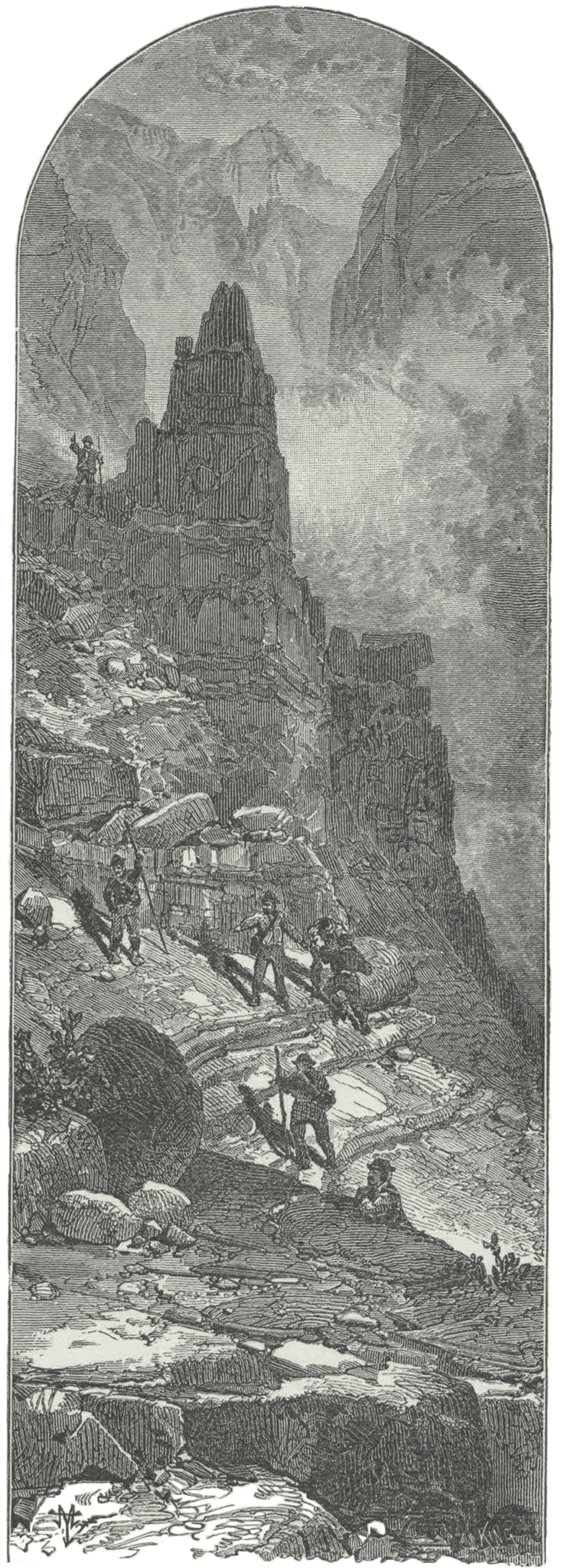
Figure 34—Climbing the Grand Cañon.
I wake my brother and tell him of Howland’s determination, and he promises to stay with me; then I call up Hawkins, the cook, and he makes a like promise; then Sumner and Bradley and Hall, and they all agree to go on.
— August 28 —
At last daylight comes and we have breakfast without a
word being said about the future. The meal is as solemn as a funeral.
After breakfast I ask the three men if they still think it best to leave us.
The elder Howland thinks it is, and Dunn agrees with him. The
younger Howland tries to persuade them to go on with the party; failing
in which, he decides to go with his brother.
Then we cross the river. The small boat is very much disabled and
unseaworthy. With the loss of hands, consequent on the departure of
the three men, we shall not be able to run all of the boats; so I decide
to leave my ‘Emma Dean.’
Two rifles and a shotgun are given to the men who are going out. I
ask them to help themselves to the rations and take what they think to
be a fair share. This they refuse to do, saying they have no fear but
that they can get something to eat; but Billy, the cook, has a pan of
biscuits prepared for dinner, and these he leaves on a rock.
Before starting, we take from the boat our barometers, fossils, the
minerals, and some ammunition and leave them on the rocks. We are
going over this place as light as possible. The three men help us lift our
boats over a rock 25 or 30 feet high and let them down again over the
first fall, and now we are all ready to start. The last thing before leaving,
I write a letter to my wife and give it to Howland. Sumner gives him
his watch, directing that it be sent to his sister should he not be heard
from again. The records of the expedition have been kept in duplicate.
One set of these is given to Howland; and now we are ready. For the last
time they entreat us not to go on, and tell us that it is madness to set out
in this place; that we can never get safely through it; and, further,
that the river turns again to the south into the granite, and a few miles
of such rapids and falls will exhaust our entire stock of rations, and then
it will be too late to climb out. Some tears are shed; it is rather
a solemn parting; each, party thinks the other is taking the dangerous
course.
My old boat left, I go on board of the ‘Maid of the Cañon.’ The three men
climb a crag that overhangs the river to watch us off. The Maid of the Cañon
pushes out. We glide rapidly along the foot of the wall, just grazing one
great rock, then pull out a little into the chute of the second fall and plunge
over it. The open compartment is filled when we strike the
first wave below, but we cut through it, and then the men pull with all their power
toward the left wall and swing clear of the dangerous rock below all right. We are
scarcely a minute in running it, and find that, although it looked bad from
above, we have passed many places that were worse.
The other boat follows without more difficulty. We land at the first
practicable point below, and fire our guns, as a signal to the men above
that we have come over in safety. Here we remain a couple of hours,
hoping that they will take the smaller boat and follow us. We are behind a
curve in the cañon and cannot see up to where we left them,
and so we wait until their coming seems hopeless, and then push on.
And now we have a succession of rapids and falls until noon, all
of which we run in safety. Just after dinner we come to another bad
place. A little stream comes in from the left, and below there is a fall,
and still below another fall. Above, the river tumbles down, over
and among the rocks, in whirlpools and great waves, and the waters are
lashed into mad, white foam. We run along the left, above this, and
soon see that we cannot get down on this side, but it seems possible to let
down on the other.
We pull up stream again for 200 or 300 yards
and cross. Now there is a bed of basalt on this northern side of the
cañon, with a bold escarpment that seems to be a hundred feet high.
We can climb it and walk along its summit to a point where we are just
at the head of the fall. Here the basalt is broken down again, so
it seems to us, and I direct the men to take a line to the top of the cliff
and let the boats down along the wall. One man remains in the boat to
keep her clear of the rocks and prevent her line from being caught
on the projecting angles. I climb the cliff and pass along to a point just
over the fall and descend by broken rocks, and find that the break of the
fall is above the break of the wall, so that we cannot land, and that
still below the river is very bad, and that there is no possibility of
a portage.
Without waiting further to examine and determine what
shall be done, I hasten back to the top of the cliff to stop the boats from
coming down. When I arrive I find the men have let one of them
down to the head of the fall. She is in swift water and they are not
able to pull her back; nor are they able to go on with the line, as
it is not long enough to reach the higher part of the cliff which is
just before them; so they take a bight around a crag. I send two men
back for the other line.
The boat is in very swift water, and Bradley is
standing in the open compartment, holding out his oar to prevent her
from striking against the foot of the cliff. Now she shoots out into the
stream and up as far as the line will permit, and then, wheeling, drives
headlong against the rock, and then out and back again, now straining
on the line, now striking against the rock. As soon as the second line is
brought, we pass it down to him; but his attention is all taken up with
his own situation, and he does not see that we are passing him the line.
I stand on a projecting rock, waving my hat to gain his attention,
for my voice is drowned by the roaring of the falls.
Just at this moment
I see him take his knife from its sheath and step forward to cut the line.
He has evidently decided that it is better to go over with the boat
as it is than to wait for her to be broken to pieces. As he leans over,
the boat sheers again into the stream, the stem–post breaks
away and she is loose. With perfect composure Bradley seizes the
great scull oar, places it in the stern rowlock,
and pulls with all his power (and he is an athlete) to turn the bow
of the boat down stream, for he wishes to go bow down, rather
than to drift broadside on. One, two strokes he makes, and
a third just as she goes over, and the boat is fairly turned, and
she goes down almost beyond our sight, though we are more than
a hundred feet above the river. Then she comes up again on a great
wave, and down and up, then around behind some great rocks,
and is lost in the mad, white foam below.
We stand frozen with
fear, for we see no boat. Bradley is gone! So it seems. But now,
away below, we see something coming out of the waves. It is evidently a boat. A moment more, and we see Bradley standing on deck,
swinging his hat to show that he is all right. But he is in a whirlpool.
We have the stem–post of his boat attached to the line. How badly she
may be disabled we know not.
I direct Sumner and Powell to pass along
the cliff and see if they can reach him from below. Hawkins, Hall,
and myself run to the other boat, jump aboard, push out, and away we
go over the falls. A wave rolls over us and our boat is unmanageable.
Another great wave strikes us, and the boat rolls over, and tumbles and
tosses, I know not how. All I know is that Bradley is picking us
up. We soon have all right again, and row to the cliff and wait until
Sumner and Powell can come. After a difficult climb they reach us.
We run two or three miles farther and turn again to the northwest,
continuing until night, when we have run out of the granite once
more.
We start very early this morning. The river still continues swift,
but we have no serious difficulty, and at twelve o’clock
emerge from the Grand Cañon of the Colorado. We are in a valley
now, and low mountains are seen in the distance, coming to the river below.
We recognize this as the Grand Wash.
A few years ago a party of Mormons set out from St. George, Utah,
taking with them a boat, and came down to the Grand Wash, where they
divided, a portion of the party crossing the river to explore the San
Francisco Mountains. Three men—Hamblin, Miller, and Crosby—taking the boat, went on down the river to Callville, landing a few miles
below the mouth of the Rio Virgen. We have their manuscript journal
with us, and so the stream is comparatively well known.
To–night we camp on the left bank, in a mesquite thicket.
The relief from danger and the joy of success are great. When he
who has been chained by wounds to a hospital cot until his canvas tent
seems like a dungeon cell, until the groans of those who lie about tortured
with probe and knife are piled up, a weight of horror on his ears
that he cannot throw off, cannot forget, and until the stench of festering
wounds and anæsthetic drugs has filled the air with its loathsome
burthen—when he at last goes out into the open field, what a world he
sees! How beautiful the sky, how bright the sunshine, what ‘floods of
delirious music’ pour from the throats of birds, how sweet the fragrance
of earth and tree and blossom! The first hour of convalescent freedom
seems rich recompense for all pain and gloom and terror.
Something like these are the feelings we experience to–night. Ever
before us has been an unknown danger, heavier than immediate peril.
Every waking hour passed in the Grand Cañon has been one of toil.
We have watched with deep solicitude the steady disappearance of our
scant supply of rations, and from time to time have seen the river
snatch a portion of the little left, while we were a–hungered. And
danger and toil were endured in those gloomy depths, where ofttimes
clouds hid the sky by day and but a narrow zone of stars could be seen
at night. Only during the few hours of deep sleep, consequent on hard
labor, has the roar of the waters been hushed. Now the danger is over,
now the toil has ceased, now the gloom has disappeared, now the firmament
is bounded only by the horizon, and what a vast expanse of constellations can be
seen!
The river rolls by us in silent majesty; the quiet of
the camp is sweet; our joy is almost ecstasy. We sit till
long after midnight talking of the Grand Cañon, talking of
home, but talking chiefly of the three men who left us.
Are they wandering in those depths, unable to find a way
out? Are they searching over the desert lands above for
water? Or are they nearing the settlements?
We run in two or three short, low cañons to–day, and on
emerging from one we discover a band of Indians in the valley below.
They see us, and scamper away in eager haste to hide among the rocks.
Although we land and call for them to return, not an Indian can be
seen.
Two or three miles farther down, in turning a short bend of the river,
we come upon another camp. So near are we before they can see us
that I can shout to them, and, being able to speak a little of their
language, I tell them we are friends; but they all flee to the rocks, except a
man, a woman, and two children. We land and talk with them. They
are without lodges, but have built little shelters of boughs, under which
they wallow in the sand. The man is dressed in a hat; the woman, in a
string of beads only. At first they are evidently much terrified; but
when I talk to them in their own language and tell them we are friends,
and inquire after people in the Mormon towns, they are soon reassured
and beg for tobacco. Of this precious article we have none to spare.
Sumner looks around in the boat for something to give them, and finds a
little piece of colored soap, which they receive as a valuable present—rather as a thing of beauty than as a useful commodity, however. They
are either unwilling or unable to tell us anything about the Indians or
white people, and so we push off, for we must lose no time.
We camp at noon under the right bank. And now as we push out we
are in great expectancy, for we hope every minute to discover the mouth
of the Rio Virgen. Soon one of the men exclaims: “Yonder’s an
Indian in the river.” Looking for a few minutes, we certainly do see
two or three persons. The men bend to their oars and pull toward them.
Approaching, we see that there are three white men and an Indian
hauling a seine, and then we discover that it is just at the mouth of the
long–sought river.
As we come near, the men seem far less surprised to see us than we do
to see them. They evidently know who we are, and on talking with
them they tell us that we have been reported lost long ago, and that
some weeks before a messenger had been sent from Salt Lake City with
instructions for them to watch for any fragments or relics of our party
that might drift down the stream.
Our new–found friends, Mr. Asa and his two sons, tell us that they are
pioneers of a town that is to be built on the bank. Eighteen or twenty
miles up the valley of the Rio Virgen there are two Mormon towns, St.
Joseph and St. Thomas. To–night we dispatch an Indian to the last–mentioned
place to bring any letters that may be there for us.
Our arrival here is very opportune. When we look over our store of
supplies, we find about 10 pounds of flour, 15 pounds of dried apples,
but 70 or 80 pounds of coffee.
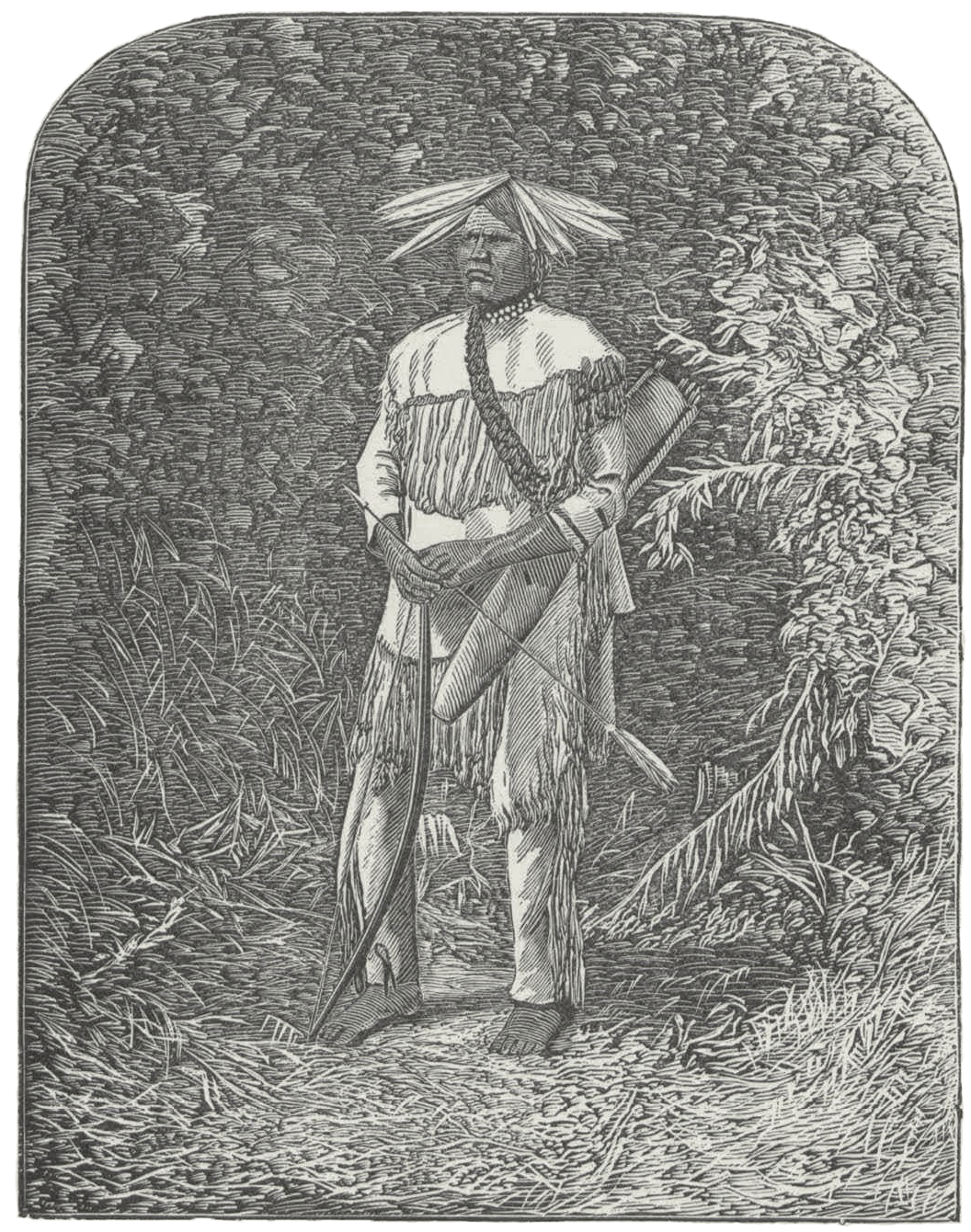
Figure 35—Our Indian messenger.
— August 31 —
This afternoon the Indian returns with a letter informing us that Bishop Leithhead of St. Thomas and two or three other Mormons are coming down with a wagon, bringing us supplies. They arrive about sundown. Mr. Asa treats us with great kindness to the extent of his ability; but Bishop Leithhead brings in his wagon two or three dozen melons and many other little luxuries, and we are comfortable once more.
— September 1, 1869 —
This morning Sumner, Bradley, Hawkins, and Hall,
taking on a small supply of rations, start down the Colorado with the
boats. It is their intention to go to Fort Mojave, and perhaps from
there overland to Los Angeles.
Captain W.H. Powell and myself return with Bishop Leithhead to St.
Thomas. From St. Thomas we go to Salt Lake City.
J.W. Powell
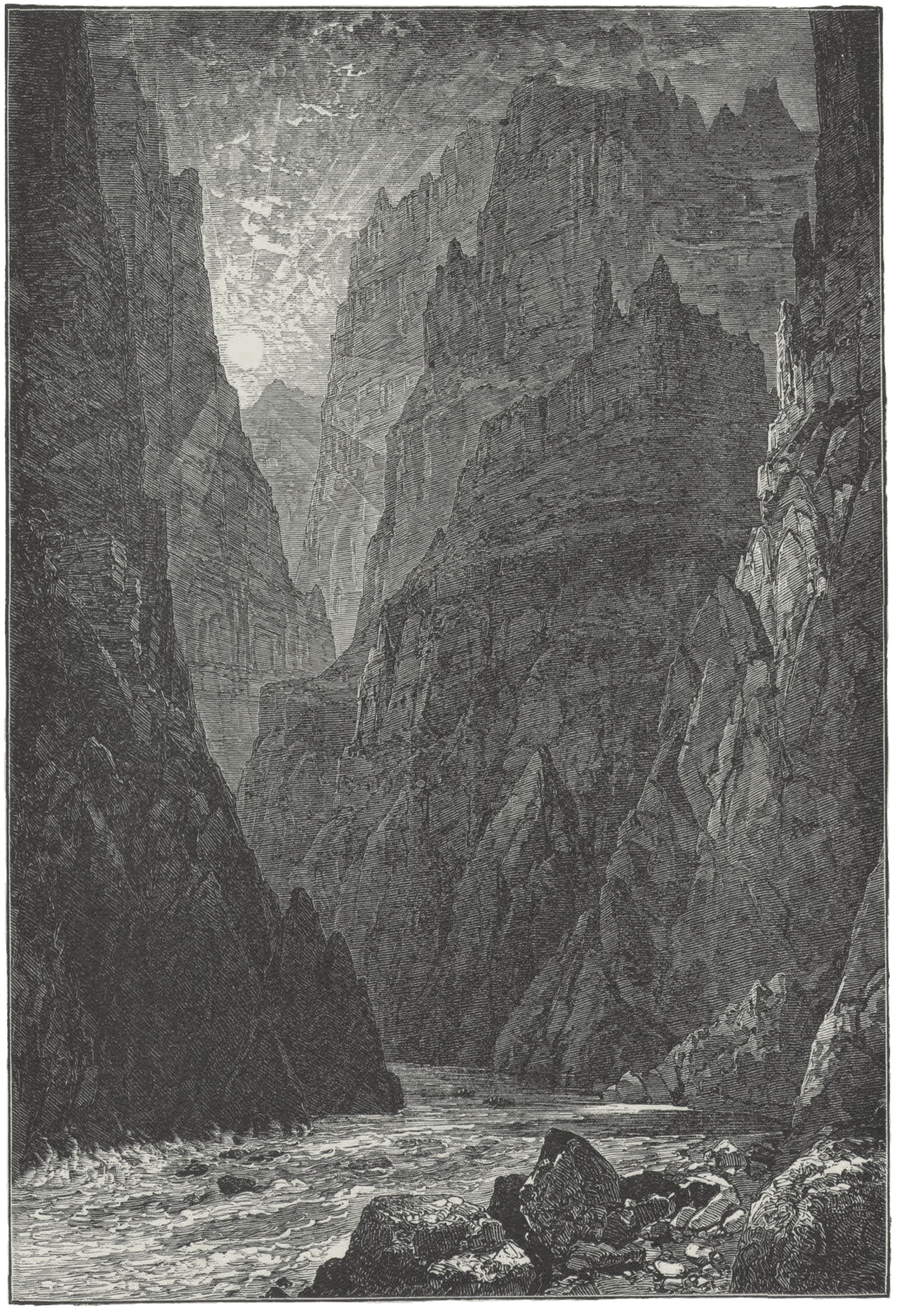
Figure 1—Grand Cañon of the Colorado. (6,200 feet deep.)
© 1875 John Wesley Powell